Why We Misjudge: Scholars Examine Misperception and Its Role in Democracy’s Struggles

In a survey of U.S. college students, Leonardo Bursztyn and his colleagues found that more than 50% of Instagram users would prefer to live in a world without Instagram.
For Bursztyn, the Saieh Family Professor of Economics at the University of Chicago, the finding shows how individuals might join markets not because the product makes their lives better in an absolute sense, but because not joining — and the fear of missing out (FOMO) — makes them feel even worse.
“Imagine if you asked the same question of people who own refrigerators and found that 50% of refrigerator owners wished refrigerators didn’t exist,” he said. “It makes no sense. Why are they buying refrigerators then?”
But this finding resonates beyond phone apps and commerce.
Studies have found that in many cases, people misjudge what others believe, value, or are willing to tolerate. And these inaccuracies can drive conflict, distrust, and escalation in polarization, partisanship, and the spread of conspiracy theories. Misperception can help explain why democracies with very different histories and institutions are experiencing parallel crises.
“These perceptions are drivers,” Bursztyn said. “Because people misperceive how others are thinking, what others believe — and that leads to social effects.”
Bursztyn joined scholars at Yale’s Institution for Social and Policies Studies for a two-day conference on “Misperceptions in Social Science Research,” organized by ISPS postdoctoral fellow Itamar Yakir. The conference was sponsored by Democratic Innovations, ISPS’s program to identify and test new ideas for improving the quality of democratic representation and governance.
“We find misperception as a recurring motif across many areas of political science and adjacent fields,” Yakir said. “It keeps popping up again and again, as both a subject and a set of methods. Not because scholars are coordinating around it, but because it has become impossible to ignore.”
Yakir brought together political scientists, economists, sociologists, and social psychologists studying misperception in the United States, Europe, and developing countries to share findings and methodologies.
They discussed how these misreadings are systematic. How once embedded in networks, markets, and media systems, they become self-reinforcing. And how individual perception often does not provide an accurate window into reality.
Yphtach Lelkes, associate professor at the University of Pennsylvania’s Annenberg School for Communication, argued that many survey responses about “what the other side believes” are not stable beliefs at all.
“These responses are often less like reports of stored beliefs and more like momentary constructions,” Lelkes said, noting that people often provide answers clouded with uncertainty, drawing on emotion, guesses, stereotypes, and social cues.
Betsy Levy Paluck, Eugene Higgins Professor of Psychology and Public Affairs at Princeton, previewed a book she is writing for a general audience on what she calls social gravity, exploring how misperceived social norms quietly pull people toward behaviors and beliefs they experience as their own.
“People don’t think that they are being influenced by others, even when they are,” Levy Paluck said. “We feel like individuals, but we act like group members.”
Researchers discussed how people do not infer norms by random sampling. They infer norms by who they notice, which often means those who are the loudest or most intense. Or those who show up the most in social media feeds, group chats, meetings, or news stories. This can explain why workplaces, online spaces, and political opponents can seem more extreme than they really are.
Jennifer Dannals, assistant professor of organizational behavior at Yale School of Management, discussed research on how being well-connected or socially central does not necessarily mean having a better grasp of what is normal.
“The people who are misperceiving the most are the people who themselves are the most central,” Dannels said, noting how these people see others who are highly active, highly visible, and like themselves. “They’re making judgments from a large sample, but a sample that is in and of itself biased.”
Gregory Huber, ISPS interim director and Forst Family Professor of Political Science, presented data in which he and his co-authors undercut a dominant narrative that mass polarization is primarily driven by wildly exaggerated misperceptions of the other side.
“We do not see evidence that people who differentially stereotype the out‑party are more affectively polarized,” Huber said, adding that the mass public has an overall accurate sense of when the issue positions held by party members are changing, and a poor sense of coalition demographics.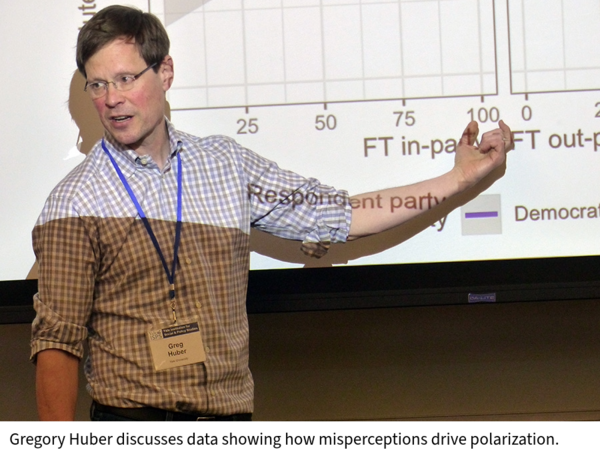
Huber urged care, symmetry, and better measurement to improve how scholars, journalists, and policymakers interpret political conflict.
“This evidence suggests the value of measuring perceptions not just of the out‑group, but also of the in‑group,” Huber said. “And doing so in a way that is legible to a survey respondent.”
Overall, conference participants concluded that people are not as divided, dug-in, or as doomed to disagree as many might believe. But people are far more socially entangled than they might understand in a system that punishes moderation and quiet agreement.
Solutions within politics, workplaces, technology, and civic engagement include creating environments where people can jointly change behavior, lower the risk of going first, and make quiet majorities more visible.
“Misperception is not a side issue — it’s a central issue,” Yakir said. “Progress requires that we share how we study misperceptions and how to correct them across disciplines and domains.”